
Ice in the Creek
Red Ranger is wintering in the water. It's cold.
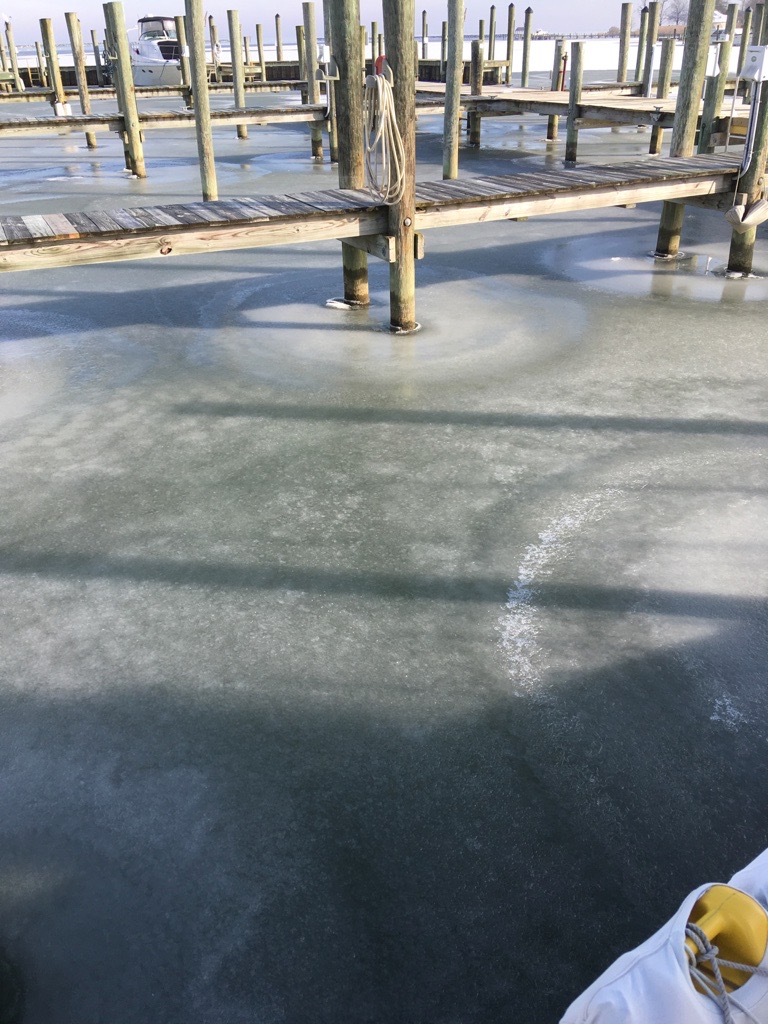
But. The ice is thin, so, it's not damaging in any way.
Last winter, the port-side deck drain hose filled with water, and then froze, and dropped off the "T" fitting under the …
Norfolk, VA
To see as much of the world as we can,
Using the smallest carbon footprint we can,
Spending the least amount of money we can,
Making as many friends we can.
Red Ranger is wintering in the water. It's cold.
But. The ice is thin, so, it's not damaging in any way.
Last winter, the port-side deck drain hose filled with water, and then froze, and dropped off the "T" fitting under the …
Snow on the decks of Red Ranger.
The footprints are a technician from one of the service companies at Herrington Harbour.
There's a strike rail around the edge of Red Ranger. It's a wooden offset, between one a two inches deep, about a foot …
Sigh.
Seasons come and seasons go. As we get on toward winter, we need to strike Red Ranger's sails, winterize Mr. Lehman, take the food out of the galley, upend all the cushions to let air circulate.
We replaced the T-shirts keeping …
I think — or perhaps I hope — I've solved a serious problem. I have a theory about diesel fuel in the bilge.
Last winter, a hose clamp for the deck drains failed. The winter rains and snowmelt poured into the engine room, and the deep bilge. It froze. The pump broke …
May as well clean.
And fix things.
This thing is the pump assembly on our Marine Sanitation Device (MSD). You might know it as a toilet.
CA's picking the paint out of the inlet valve packing nut.
The forward cylinder (with the …
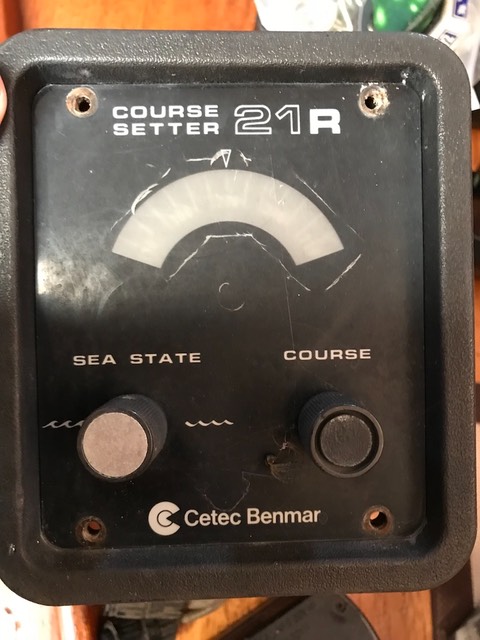
For years, we turned the helm over to our trusted crew member, Midshipman, Mr. Benmar.
While he was rugged, reliable, and patient, it was always a kind of crap-shoot to see what Mr. Benmar had in mind. Roll the dice. Perhaps you were on course, perhaps not …
The hull paint was chipped in some places. Down to a thin layer in others.
We touched it up.
The bulk of the bottom paint is in good shape. We hope this little touch-up will reduce barnacle and algae damage for another …
The Whitby design has a fairly large number of through-hull fittings. They let water in (and out) of the boat in a controlled fashion. For fittings below the waterline, we have huge bronze valves — sea cocks — to be sure we can close off the hole in case a hose fails …
We've moved the deck drain hoses. The Whitby has wonderful bulwarks that trap water running over the decks. The original Whitby design had hoses that ran from deck drains to through-hulls below the waterline. It's an elegant idea that keeps the cockpit dry and makes sure dropped tools don't always …
Red Ranger uses "raw" water for a number of things: flushing the forward head, rinsing in the galley sink, cooling the engine, washing down the anchor. Once upon a time, it also had air conditioners, a fridge, and an aft head that used raw water also.
All of the raw …
House batteries were nearly dead. See House Batteries for their last days.
I have a theory that ice in the bilge may have frozen the switch in the on position, and the motor's overheat protector kicked on and off over a period of weeks, running the batteries down in the …
The house batteries date from September 2011. We've gotten a hair over six years of service from batteries that are normally replaced every five years. They're not stone dead. See Sudden Death—Joys and Concerns for details of the last time they died.
They're not dead. But. They're barely …
When we lived aboard, we didn't winterize. Winterizing is a potentially big job. But we think we're getting a grip on it. Except for one thing. And this year, it was a problem. So we had to do some diagnostic work.
Here's the …
The whole story is kind of complex. The bottom line is that we have a counter-top issue in Red Ranger's galley. A serious "Concern". Or maybe Concern in bold.
There are two strategies available. (Three, if "Ignore It" is a strategy.)
Replace the counter top with a new counter top …
The Whitby has a dozen opening portlights. Plus three hatches.
In the bright, tropical sun, it can get warm. Really warm.
The previous owner had curtains. We took those out because they're dust and mildew catchers.
We tried to make window shades from HDPE board. If you're careful, you can …
The bottom of the Chesapeake involves silt. A lot of it. Anchoring in silt is kind of fun. You barely have to think about it. Except, of course, for the silt that stays with your anchor chain.
When we first started sailing down here, we heard an old salt explain …
We used to carry two spare anchors on deck. We have two on the bowsprit, ready for use.
Yes, that's four anchors. If we need to stay put, we can.
On the left is a CQR. ("Secure", get it …
When we lived aboard, we didn't think much about the water tanks. Correction. We thought about how full they were, but that was the limit. In the Bahamas we got water periodically in two 5-gallon jerry jugs. This kept the tank levels steady. In the US, we had a 30 …
There's a love-and-care gap exposed by visiting the Red Ranger only on weekends. This leads to weirdness.
Once upon a time, we covered so many miles in one year (something like 2,000) that oil changes happened pretty often. It's about 200 hours, which (at 6 knots) is about 1 …
First, and most important, the main saloon hatch leaked. But, there's also this issue of preserving data from the old chart plotter. You know how some projects just spin out of control? Those are the projects that tend to dredge up historical artifacts.
Here's the …