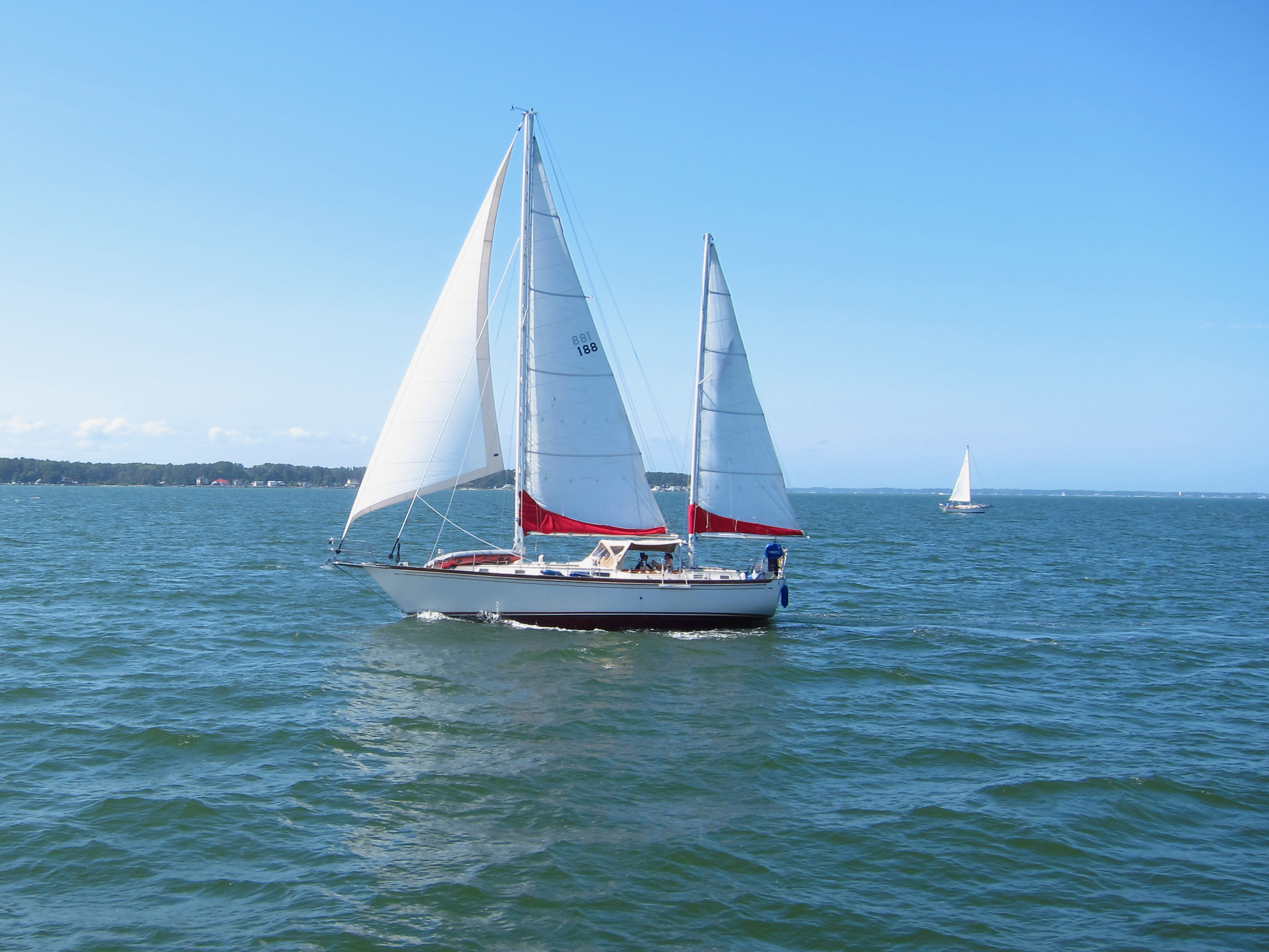

Yes. I know it's really the tail end of 2024.
Years ago -- in the Chesapeake -- our boat year started mid-May, so we could get out and sail on Memorial Day weekend.
Now. In Florida, we're escaping Hurricane Season; the boat year is December to April or May. So. I'm calling this the start of the 2025 season.
We have a checklist for commissioning. Which includes two major repairs.
- The circuit breaker for the fresh water pump.
- Mr. Lehman. He idled beautifully, but failed to maintain power. Starved of fuel, he'd die. I'd bleed the fuel lines, and he started right back up.
Circuit Breaker
How hard can it be? Pull the breaker. Put in a new one.
Sadly, the Sensata/AIRPAX breakers are not wildly popular, and kind of hard to find. I order from https://Onlinecomponents.com and wait for several weeks for fulfillment. I'm big on color-coded paddles -- green for things that are always on; red for things that are rarely on; white for ordinary things that are generally left on. Black for the running lights.
The nuance is that the breakers come with 1/4" wide tabs that you can slide female connectors onto. The boat's breaker panel has a brass buss-bar with screw holes that screw into the breaker's little tab. That means drilling a 9/64" hole in the tab that goes to the bus-bar. (Drill the tab on the "on" side of the switch.)
Got that done. Got the tiny #6 screw into the bus-bar. And the pump doesn't make a sound.
Ugh.
Okay. Pull up the cabin sole.
Put the voltage meter on the pump. And. There's voltage. But no pumpage.
Nothing like cascading problems. Fixing the switch reveals a problem in the pump (or the wiring.)
Water Pump
CA finds a spare water pump that we'd been saving. I'm not sure why. It was in a box that looked new. The pump looked old.
I wired it into the circuit. It didn't pump, either. So, it's no good. (Take it to the dumpster.)
The box says "fused to 10A". Ah. An internal fuse.
I open the little cover on the wiring for the pump we just removed. There are wires that connect to metal tabs. There is no obvious fuse. This little block of plastic with wires attached is on top of the pressure sensor. I'm reluctant to open it further.
On a lark, I reassembled it. And then, put the original motor back into the circuit.
Pumpage!
It makes all the right noises now.
I'm guessing the problem was a loose connection that -- after fiddling around with it for a while -- is no longer as loose as it once was. I deeply suspect the male-female spade connection. I think the female side was merely inside the insulating shield, not mechanically connected to the male.
Okay. Fresh water breaker is fixed. And the pump works, too.
Ordering Sensata Airpax replacements
A side-bar on the Sensata Airpax part numbers.
I think I can order T11-51-15.0A-cc-20S, where cc is the color: 01 Black, 02 Red, 03 Yellow, 04 Green, 05 Blue, 06 White. The final "S" in the part number is for a screw hole in the tab. I generally haven't tried to order this version with the "S" at the end; I think because it's really unpopular, and I'd have to order a ton of them to get the minimum order size. Someday, I should try it and see what happens.
Diesel Fuel Flow
A post on Facebook for Ford Lehman engines described our problem: runs for a half-hour and dies. One of the suggested fixes was to check the air vent for the fuel tank. I've been waiting for months to look at this.
I've got spare secondary filters. I've got spare crushable copper washers. I've got a lot of parts that might be helpful.
The vent line goes from fuel tank into the aft hanging lockers and from there, straight up to the side of the cabin top. The vent line goes through a Parker LifeGuard Fuel/Air Separator, an LG-100. This goes in the vent line. It prevents fuel from spilling out of the vent when taking on fuel. It could -- perhaps -- be blocked. Or the external vent port could be blocked. Or -- well -- I don't know.
Step 1. Open up the lines. Take the hose clamps off, and pry the LG-100 out of the vent lines.
Before starting step 1, get a bucket.
The theory is something's plugging the vent line.
It could turn out to be the fuel.
Step 2. After working the vent hose off the bottom of the LG-100, I point the vent hose into the bucket. Out runs a splash of fuel.
How much?
It's enough to wet the bottom of the bucket. A few ounces. More than a shot. Maybe 1/4 cup.
Step 3. Blow air into the tank. And. The tank blows diesel fumes right back at me.
Step 4. Blow air out the vent. Go outside and see if there's a wasp's nest in the vent (there isn't.) Okay.
It's essentially clear.
But. About that 1/4 cup of fuel. That's about 3.6 cubic inches of fuel.
First. There's a low spot in the vent line. The Parker installation guide for the LG-100 says there should not be a low spot.
It's 3/8" vent line. Volume of a cylinder is \(\pi d \times h\). \(d = \tfrac{3}{8}\). Therefore, each inch of hose is another \(\tfrac{3 \pi}{8} \approx 1.17\) cubic inches of possible fluid.
About 3" of a "low spot" in the vent line could hold about a 1/4 cup of fuel. About 4" of a low spot would block 3/4 of the air coming in. 5" would block 3/5 of the air coming in. All bad for higher rates of fuel consumption.

Was this it?
Two years ago Red Ranger was rolled on her side. Fuel could have slopped out of the tank into the vent line.
Last year, we had trouble keeping the engine running.
1/4 cup of fuel in the vent? Could be.
The Whole List
FWIW, this is the base list we start with. (We're re-arranging it because things aren't in any kind of rational grouping of tasks.)
Day 1:
- [ ] rig bimini
- [ ] apply 303 to bimini
- [ ] wash deck teak
- [ ] wash deck
- [ ] wash solar panels
- [ ] wash port lights and lubricate gaskets
- [ ] inspect running rigging
- [ ] clean fresh water tanks
- [ ] paint numbers on Scout
- [ ] change engine oil (Filter and 9qt 30W)
- [ ] change outboard lower-unit lube (90W) and crankcase oil (15W-40)
- [ ] Check outboard lifting strap


Day 2:
- [ ] rig main and mizzen (Can be deferred at Safe Cove)
- [ ] rig foredeck solar panels
- [ ] rig anchors
- [ ] rig fenders
- [ ] rig whisker pole
- [ ] rig life sling and throwable
- [ ] check hose clamps below water line
- [ ] clean raw water strainer


Day 3:
- [ ] clean port fresh water tank
- [ ] check expiration date on flares
- [ ] Touch up paint
- [ ] Fill tanks
- [ ] Change engine zinc
- [x] replace prop zinc

Day 4 (at dock):
- [ ] clean starboard fresh water tank
- [ ] fill water tanks
- [ ] wash shore power cord before stowing.
- [ ] clean port fresh water tank
(We started with prop zinc already done because the bottom was painted after we got knocked down.)